The term job purpose permeates my writing. It’s not lost on me that some readers will be asking, “What’s the point of articulating a job role’s purpose? Isn’t this just a theoretical exercise with little or no application or benefit inside the real world of work?” That’s a question that, as you may have guessed, I’ve heard before. I’ll tackle it now.
Every job role is made up of two dimensions and three parts. These are illustrated in the Venn diagram below.
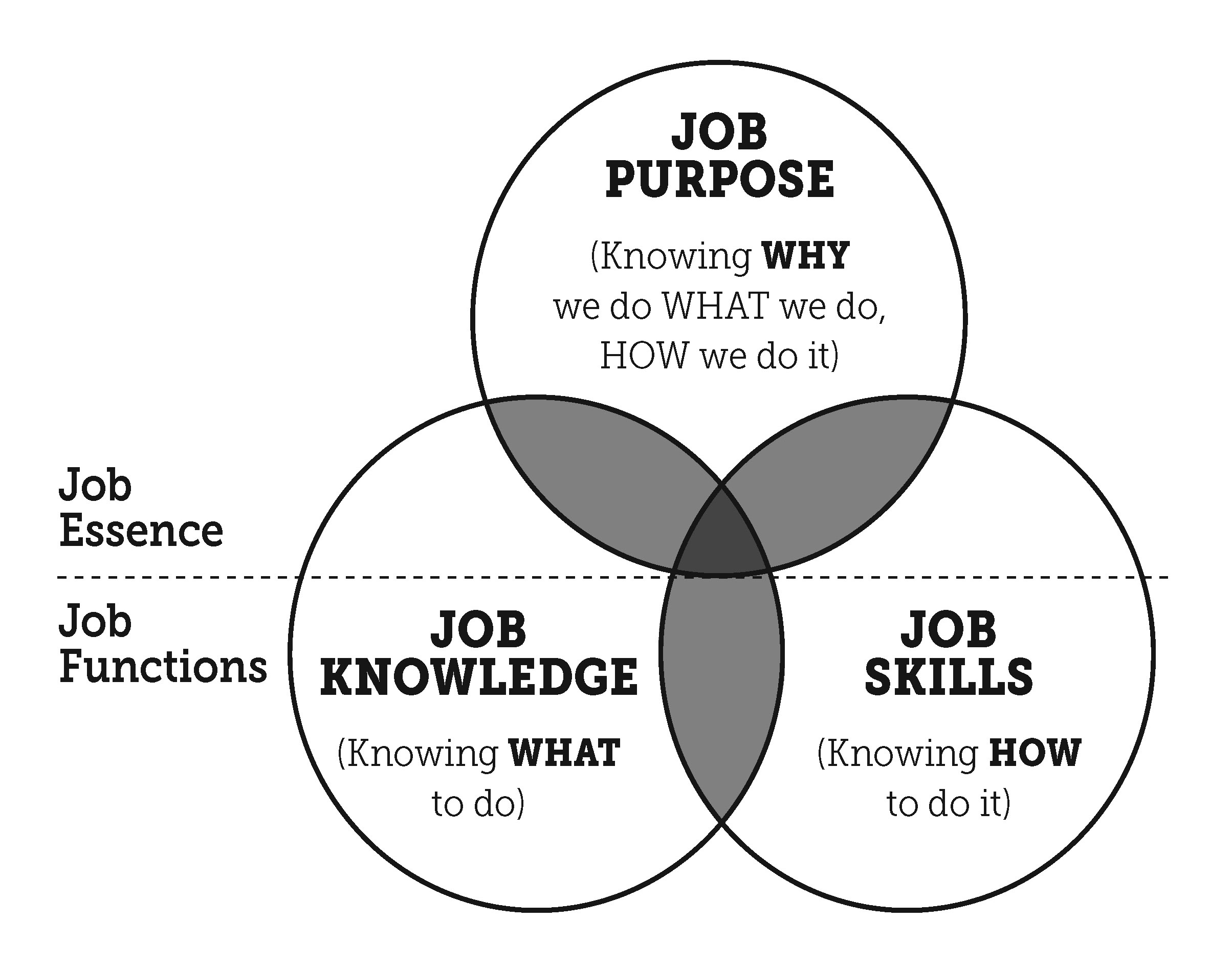
The first dimension is job functions; the duties and tasks related to a job role. This dimension is comprised of two parts: job knowledge and job skills. Job knowledge refers to the information employees need to know to perform their job role. It’s WHAT employees must know to perform their role and may include company policies and procedures, pricing, product specifications, etc. Job skills represent the abilities that employees must demonstrate to properly execute their job responsibilities. These skills inform employees about HOW the work is to be done to effectively perform their job role and may include customer service, time management, communication, keyboarding, etc.
If employees possess adequate job knowledge and display sufficient job skills, they are deemed competent to reliably execute job assignments. This is where most supervisors, managers, and leaders stop in terms of defining the totality of a job role. As a result, this is where most frontline employees’ potential is unwittingly capped by their immediate supervisor. And engagement surveys reveal that most of these employees, who view their jobs as routine and monotonous, are bored at work.
The second dimension of every job role is job essence; the most important aspect of the job role. This dimension is comprised of job purpose. Job purpose is the job role’s single highest priority. It represents WHY employees do WHAT they do, and HOW they do it at work. An employee’s WHY may be to surprise and delight every customer, to inspire confidence, to reduce customer effort, or to create promoters of the company. The possibilities are endless. It simply requires leadership to be intentional about articulating the higher purpose of the organization and job role, revealing these to employees, and linking them to employees’ daily work activities.
Where the circles intersect is where the magic happens. It’s the performance sweet spot; the area where engaged employees and delighted customers flourish.
Think about it: If employees possess adequate job knowledge, demonstrate sufficient job skills, and reflect job purpose in the execution of their duties and tasks, they are not only deemed competent to reliably perform job assignments (and equipped to satisfy customers by meeting expectations), they are also distinguished as motivated, connected, and engaged (and equipped to delight customers by exceeding expectations). Engagement surveys affirm that these employees are not bored at work, they’re on-board with the organization’s mission, vision, or purpose.
So, how does the theoretical exercise of articulating the higher purpose of the organization and job role, revealing them to employees, and linking them to employees’ daily work activities apply to employees’ real world of work?
Let’s consider an example from Disney. Have you ever been a passenger on the Jungle Cruise ride at Disneyland? The cast member acting as the skipper on your cruise has been carefully screened via Disney’s sophisticated selection process, so you already expect that he will be exceptional. You will not be surprised to be greeted by an engaged, smiling, uniformed tour guide who conveys authentic enthusiasm for hosting guests on the cruise.
As the ride gets underway, the guide transitions from spontaneous banter with guests (job skills; communication and customer service) to a carefully rehearsed script (technical job knowledge) that incorporates job essence into the job functions related to acting as a skipper on the Jungle Cruise. This job essence (in fulfillment of Disney’s job purpose: to create happiness) may take the form of sharing unique knowledge, using appropriate humor, or providing pleasant surprises.
As you approach a large open stretch of water, your guide might say, “We’re going down the Nile River. At 4,132 miles, it’s the longest river in the world. It goes on for Niles and Niles and Niles.… If you don’t believe me, then you’re in denial.”
Then, as you encounter a hostile (animatronic) rhino on the right side of the boat, your guide says, “That’s why you don’t want to argue with a rhino. They always get their point across.”
By carefully crafting their tour scripts, within the parameters established by Disney management (job functions) and in alignment with Disney’s aspiration to create happiness by providing the finest in entertainment for people of all ages, everywhere (job purpose), cast members are intentional about incorporating job essence into their job functions. Whether or not you laugh, learn something new, or are pleasantly surprised on the Jungle Cruise ride should not hinge on the skipper you happen to get. Embedding unique knowledge, appropriate humor, and pleasant surprises into the script ensures a consistent guest experience from cruise to cruise regardless of the cast member involved.
Articulating, revealing, and connecting job purpose to employees’ real world of work enables them to perform (reflect job purpose) beyond the confines of a narrow job description that is typically limited to job functions that outline the job knowledge and job skills required of the job role. Doing so also translates an amorphous corporate ideal into a concrete set of actions and behaviors that reflect the higher purpose of the organization and job role.
Thanks for reading. Explore this topic further in my latest book, The Revelation Conversation: Inspire Greater Employee Engagement by Connecting to Purpose.